
[ Project Overview ]
A harmonised indicator framework for Europe's food services.
Despite the ambitions of the European Green Deal and the Circular Economy Action Plan, the food service sector still lacks sector- specific indicators to measure and govern its circular performance. CIRCULARIS closes that gap by co-developing harmonised, digitally-enabled CE indicators tailored to restaurants, hotels, retailers, takeaways and food producers — and by validating them in three real-world Mediterranean pilots.
– Duration
36 Months
May 2026 – April 2030
– Grant Agreement
№ 101292246
HORIZON-CL6-2025-01
– Consortium
10 partners
6 European countries
– Pilots
3 Mediterranean sites
GR · IT · CY
– Challenge
Why food services, and why now.
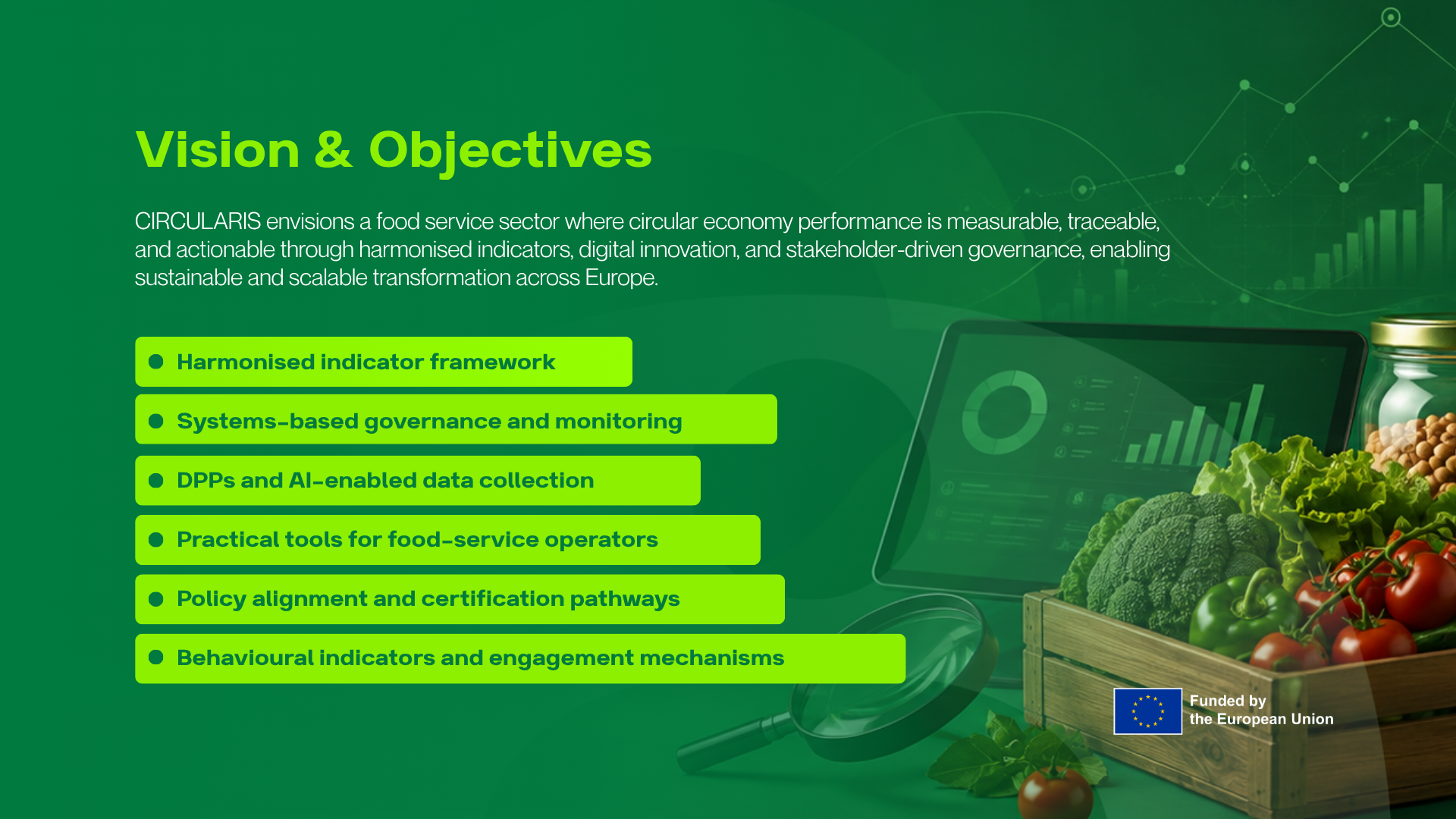
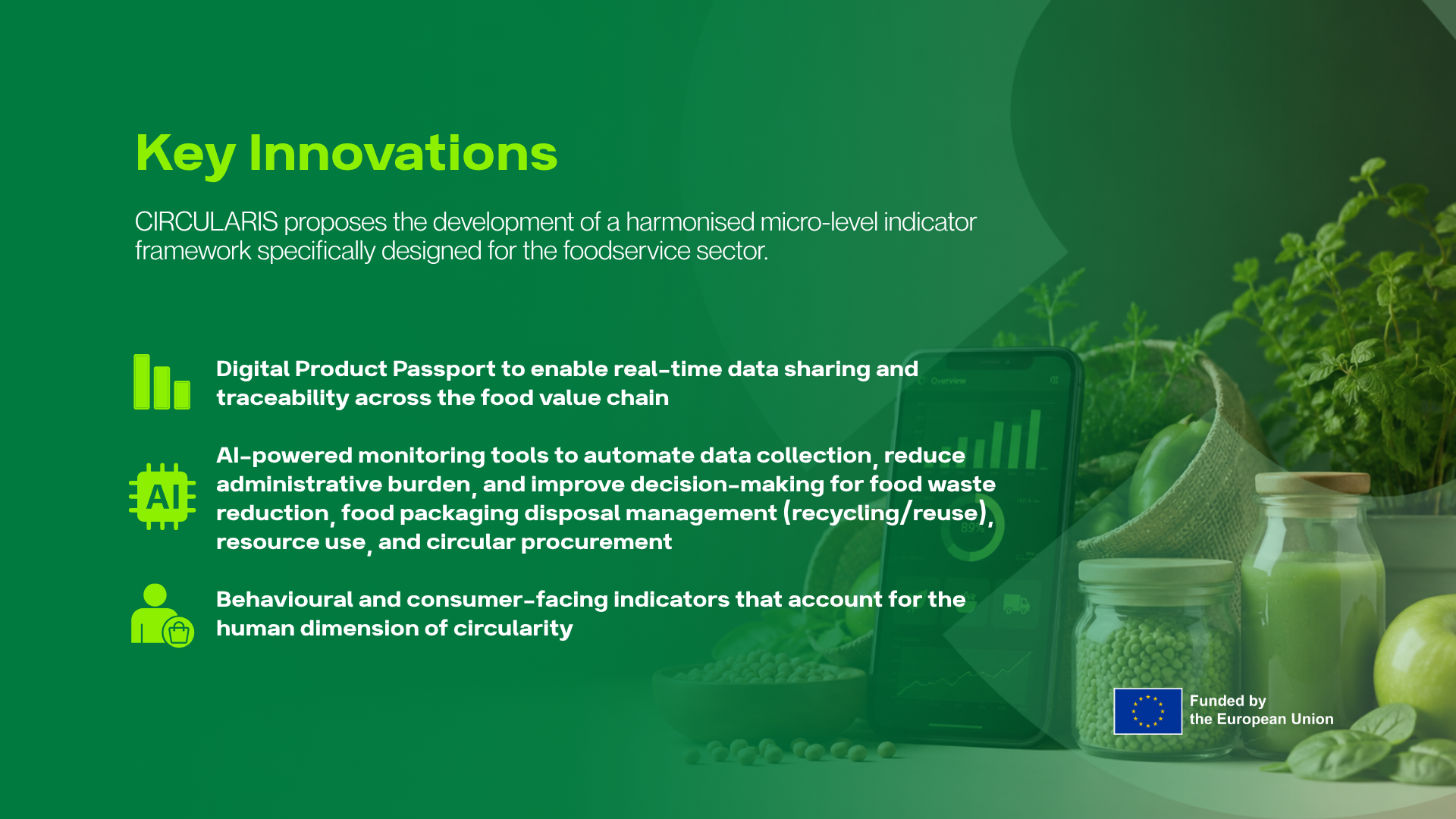
Although food service plays a significant role in resource consumption, food waste generation, packaging use, and environmental impacts, the sector currently lacks harmonised methods and indicators for assessing its circular economy performance. CIRCULARIS Project aims to fill this gap by developing a harmonised framework of circularity indicators tailored to the specific needs and characteristics of food service sector. The framework will support the measurement and improvement of performance in areas such as resource efficiency, waste prevention, food waste reduction, reuse, recycling, sustainable procurement, and circular business practices. To strengthen the practical application of circular economy principles, the project will combine digital technologies, Artificial Intelligence, data-driven solutions, and Digital Product Passports (DPPs) to improve data collection, interoperability, traceability, and transparency across the food service value chain.
By transforming fragmented information into reliable and actionable insights, CIRCULARIS will enable food service operators and other stakeholders to make more effective, evidence-based decisions and identify opportunities for reducing resource consumption and environmental impacts. At the same time, the project will bridge the gap between circular economy theory and practice by providing practical tools, guidance, and governance approaches that can be adopted by businesses, policymakers, researchers, and other actors. Through strong collaboration across the European ecosystem, CIRCULARIS seeks to create a common approach to measuring circularity, support the scaling of successful circular practices, and contribute to a more efficient, transparent, resilient, and sustainable European food system.
SO.01
Develop a harmonised framework for micro-level Circular Economy indicators
Create and validate a standardised framework of CE indicators for the food service sector, enabling consistent measurement, benchmarking, and monitoring of circularity performance.
SO.02
Link CE indicators to circular activities and systemic success metrics
Develop recommendations connecting indicators with CE practices, resilience, governance, and policy objectives to support evidence-based decision-making.
SO.03
Develop and validate digital, sector-specific CE indicators
Create and pilot a harmonised set of food-service CE indicators supported by Digital Product Passports, AI tools, and digital monitoring systems.
SO.04
Adapt CE principles to real-world food service operations
Bridge the gap between CE theory and practice by ensuring indicators and solutions are operationally feasible and applicable across diverse food-service contexts.
SO.05
Position CE indicators as governance and certification tools
Develop certification schemes and governance mechanisms that incentivise CE adoption and influence business behaviour across different socio-economic contexts.
SO.06
Enhance consumer awareness and participation in circularity
Develop digital engagement tools and awareness mechanisms that increase consumer understanding and participation in Circular Economy practices.
– Continue